A language model proposes hypotheses from the lab’s research and recent arXiv papers. Each entry retains its generation source and identifies any subsequent corrections to its content.
AI-generated hypotheses for further examination. Generation sources and subsequent content corrections are shown on each entry. About these entries
Entries shown: 22
Affective Neuroscience
Predicting Emotion from EEG with Spatio-Temporal Alignment Mixture-of-Experts
시공간 정렬 MoE 모델로 EEG 감정 예측
Hypothesis
A spatio-temporal alignment Mixture-of-Experts (MoE) model, pre-trained on diverse EEG datasets, can robustly decode emotional states across individuals and recording settings.
Rationale
The lab studies emotion with EEG. Adapting a novel MoE architecture designed for generalizability across EEG decoding challenges could improve the robustness of emotion recognition.
Related lab research
Affective Neuroscience: Awe, Memory, and Aesthetic Experience
The Neuro-X Project: Brain Foundation Models
Research informing the idea
STEAM: A Spatio-TEmporal Alignment Mixture-of-Experts Model with Hierarchical Pre-training for EEG Decoding
DIVER-0: Fully Channel-Equivariant EEG Foundation Model
Proposed experiment
A STEAM-like model would be pre-trained on publicly available EEG emotion datasets (e.g., DEAP, SEED) and fine-tuned on the lab's VR-EEG affective dataset, evaluating emotion classification accuracy and cross-subject generalization metrics.
Risks and limitations
The MoE architecture may introduce significant computational overhead, making real-time application in VR challenging without further optimization.
Agentic AI
Agentic AI for Cross-Modal EEG-fMRI Data Integration
EEG-fMRI 교차 모달 데이터 통합을 위한 에이전트 AI
Hypothesis
An agentic AI system could autonomously design and execute optimal preprocessing and fusion pipelines for multimodal EEG and fMRI datasets, improving integrated analyses for affective neuroscience questions.
Rationale
The lab frequently works with multimodal data (EEG/fMRI), but manual pipeline design is time-consuming. Agentic AI, a nascent interest in the lab, could automate and optimize this complex process, extending current capabilities for data integration.
Related lab research
The Neuro-X Project: Brain Foundation Models
Affective Neuroscience: Awe, Memory, and Aesthetic Experience
Research informing the idea
EEG-JEPA: Structured Latent Prediction for EEG Foundation Models
Can Natural Image Autoencoders Compactly Tokenize fMRI Volumes for Long-Range Dynamics Modeling?
Proposed experiment
An agent could be tasked to identify optimal preprocessing steps (e.g., noise reduction, artifact removal) and fusion techniques (e.g., joint ICA, deep learning fusion) for a combined EEG-fMRI dataset aimed at predicting emotional states, using a performance metric like classification accuracy.
Risks and limitations
Designing an agent with sufficient neuroscientific domain knowledge to robustly generalize across diverse datasets and research questions poses a significant challenge.
Connectomics
Foundation Models for Multi-Scale Connectomics with PIMSM
PIMSM을 활용한 다중 스케일 연결체학 파운데이션 모델
Hypothesis
Adapting Physics-Informed Multi-Scale Mamba (PIMSM) to connectomics could enable more stable and generalizable representations of structural and functional brain networks across different scales and populations.
Rationale
The lab has developed PIMSM for stable neural representations but has yet to apply it directly to connectomics. Combining the inherent multi-scale nature of connectomes with PIMSM's physics-informed architecture offers a novel approach to learning robust brain network models.
Related lab research
The Neuro-X Project: Brain Foundation Models
Research informing the idea
PIMSM: Physics-Informed Multi-Scale Mamba for Stable Neural Representations under Distribution Shift
Latent-Space Causal Discovery from Indirect Neuroimaging Observations
Proposed experiment
PIMSM could be trained on multi-scale connectome data (e.g., derived from dMRI for structural and fMRI for functional connectivity) from a developmental cohort (e.g., ABCD) and evaluated on its ability to predict individual cognitive performance or mental health outcomes, comparing against traditional graph neural network approaches.
Risks and limitations
Integrating diverse connectomic data modalities and scales into a single physics-informed framework without losing critical information or introducing biases is complex.
Agentic AI
Agentic AI for Cross-Modal Neuroimaging Pipeline Optimization
교차 모달 신경영상 파이프라인 최적화를 위한 에이전트 AI
Hypothesis
An autonomous AI agent could intelligently explore and optimize multimodal neuroimaging analysis pipelines, adapting them across fMRI and EEG data for specific research questions, leading to more robust and generalized findings.
Rationale
The lab already works with fMRI (NeuroMamba) and EEG (DIVER) foundation models. An agentic AI that can autonomously integrate and optimize these diverse modalities for specific research aims would be a powerful tool for accelerating neuroimaging research.
Related lab research
The Neuro-X Project: Brain Foundation Models
Research informing the idea
EEG-PRIME: Prototype-Aligned Representation Learning with Multi-Level Conditioning for EEG Decoding
PIMSM: Physics-Informed Multi-Scale Mamba for Stable Neural Representations under Distribution Shift
Proposed experiment
An agent could be designed to explore parameter spaces and model combinations (e.g., pre-trained DIVER for EEG and NeuroMamba for fMRI) to optimize a cross-modal prediction task, such as predicting affective states from combined EEG and fMRI data. The agent's performance in discovering optimal pipeline configurations would be benchmarked against manual optimization.
Risks and limitations
Defining robust evaluation metrics and objective functions for an autonomous agent to optimize complex neuroimaging pipelines without human oversight is challenging.
Agentic AI
Agentic AI for Automated Multi-Modal Causal Discovery in Developmental Cohorts
발달 코호트의 다중 모드 인과 관계 발견을 위한 에이전트 AI
Hypothesis
An agentic AI framework capable of iteratively generating hypotheses and designing experiments for causal discovery on multi-modal developmental data (genes, brain, behavior, environment) can uncover previously unknown relationships more efficiently than manual approaches.
Rationale
The lab's focus on agentic AI for brain research and multi-modal genetics/computational psychiatry makes this a natural extension. Leveraging AI for hypothesis generation in complex causal discovery is a novel application.
Related lab research
Polygenic architecture of brain structure and function, behaviors, and psychopathologies in children
Latent-Space Causal Discovery from Indirect Neuroimaging Observations
Research informing the idea
Polygenic architecture of brain structure and function, behaviors, and psychopathologies in children
Proposed experiment
An agent would be designed to ingest ABCD data (polygenic scores, MRI, behavioral, environmental measures) and a predefined set of causal discovery algorithms. It would then generate and test causal graphs, prioritizing those with higher statistical evidence and novelty, to identify associations among genes, brain, and behavior related to childhood development.
Risks and limitations
The agent's ability to generate truly novel and testable hypotheses, rather than simply rediscovering known associations, may be limited, and interpreting its generated causal graphs could be challenging.
Agentic AI
Agentic AI for EEG Foundation Model Interpretability
EEG 파운데이션 모델 해석 가능성을 위한 에이전트 AI
Hypothesis
An agentic AI system, leveraging EEG-PRISM's physiological mapping capabilities, can autonomously explore and generate hypotheses about the neurophysiological underpinnings of EEG foundation model predictions.
Rationale
Interpreting complex EEG foundation models is challenging. Combining agentic AI with physiologically-grounded interpretability methods like EEG-PRISM offers a novel path to automated hypothesis generation in brain research.
Related lab research
DIVER-0: Fully Channel-Equivariant EEG Foundation Model
The Neuro-X Project: Brain Foundation Models
Research informing the idea
EEG-PRISM: Physiologically-Grounded Interpretability of Predictions by EEG Foundation Models
Proposed experiment
An initial test would let an agent use EEG-PRISM to map time-channel attribution scores from an EEG model such as DIVER-0 into frequency and source domains. Experts would assess the resulting hypotheses for plausibility and testability.
Risks and limitations
The agent's ability to generate truly novel and biologically plausible hypotheses might be limited by the explicit knowledge embedded in its prompts or the quality of EEG-PRISM's physiological mapping.
Affective & Developmental
Polygenic Influence on Affective Dynamics in Adolescents
청소년 감정 역학에 대한 다유전자 영향
Hypothesis
Polygenic scores for depression or anxiety may predict differences in adolescents' affective change, with longitudinal brain measures accounting for part of the statistical association.
Rationale
The lab studies how genetic, brain, behavioral, and environmental measures relate during development. A candidate extension is to connect polygenic scores and brain dynamics to repeated measures of emotion.
Related lab research
Polygenic risk-informed white matter integrity
Polygenic scores for psychiatric traits mediate the impact
Slower cardiac-coupled cortical dynamics link depressive symptoms
Research informing the idea
Polygenic architecture of brain structure and function, behaviors, and psychopathologies in children
Proposed experiment
Check which repeated emotion and symptom measures are available in ABCD, then relate them to polygenic scores and longitudinal fMRI. Test a statistical mediation model with prespecified covariates; indirect associations alone would not establish a causal pathway.
Risks and limitations
Emotion reports and fMRI dynamics may capture different timescales, polygenic prediction may be weak, and confounding can produce apparent mediation.
Quantum ML
Quantum-Resilient Brain-Language Alignment
양자 잡음에 강한 뇌-언어 정렬
Hypothesis
Applying Discretization-Aware Fine-Tuning (DAFT) to brain activity representations before quantum encoding will improve the robustness and accuracy of brain-language alignment on noisy quantum hardware.
Rationale
DAFT addresses information loss when chemical-model representations are discretized for quantum encoding. Its relevance to brain data, and any robustness to hardware noise, are separate questions to test alongside the lab's QML and brain-language research.
Related lab research
Quantum Time-Series Transformer
Mind the Gap
Hybrid Quantum Temporal Convolutional Networks
Research informing the idea
Discretization-Aware Fine-Tuning for Quantum Machine Learning with Chemical Foundation Models
Mind the Gap: Aligning the Brain with Language Models Requires a Nonlinear and Multimodal Approach
Proposed experiment
Train a DAFT-inspired fMRI encoder and Quantum Time-Series Transformer to align brain and language embeddings. Compare matched baselines under both ideal and noisy quantum simulation to separate encoding effects from noise robustness.
Risks and limitations
Encoding gains may not transfer from chemical to brain representations or provide a benefit under hardware noise; fine-tuning may also be too costly.
Affective Neuroscience
Frequency-Domain Interpretability for EEG Foundation Models in Affective States
정서 상태 EEG 파운데이션 모델의 주파수 영역 해석 가능성
Hypothesis
Applying physiologically-grounded interpretability methods to EEG foundation models will reveal specific frequency-domain signatures predictive of distinct affective states (e.g., awe vs. fear), advancing our understanding of emotional processing.
Rationale
The lab actively researches affective neuroscience, including awe. Interpretable EEG foundation models can bridge the gap between complex model predictions and physiologically meaningful insights into emotions.
Related lab research
Affective Neuroscience: Awe, Memory, and Aesthetic Experience
fMRI & EEG Foundation Models
Research informing the idea
EEG-PRISM: Physiologically-Grounded Interpretability of Predictions by EEG Foundation Models
Understanding and Correcting Low-Frequency Bias in EEG Foundation Model
Proposed experiment
Train an EEG foundation model on an affective EEG dataset (e.g., emotions induced by music/videos). Apply EEG-PRISM to convert time-channel attribution scores into frequency-domain power changes, then correlate these changes with self-reported affective state ratings (valence/arousal) using statistical measures.
Risks and limitations
The quality of attribution maps can be noisy, and directly linking specific frequency changes to discrete emotional states might be oversimplified or lack specificity.
Agentic AI
Neuro-Agentic Hypothesis Generation for Personalized Connectomics
개인화된 커넥토믹스를 위한 뉴로 에이전트 가설 생성
Hypothesis
An agentic AI system, leveraging multimodal neuroimaging and genetics, can autonomously generate novel, testable hypotheses about individual differences in brain connectomics and their relation to psychiatric traits, outperforming human experts in novelty and precision.
Rationale
The lab already works with multimodal genetics and connectomics. Agentic AI can now integrate vast, complex datasets to identify subtle, non-obvious patterns, accelerating hypothesis generation for personalized medicine.
Related lab research
Computational Psychiatry & Multi-Modal Genetics
The Neuro-X Project: Towards Large Brain Models
Research informing the idea
Mind the Gap: Aligning the Brain with Language Models Requires a Nonlinear and Multimodal Approach
Proposed experiment
Train an agentic AI with access to structural and functional connectome data (e.g., from ENIGMA-OCD or ABCD), polygenic scores, and clinical phenotypes. Evaluate its generated hypotheses against expert-curated ones using a panel of neuroscientists for novelty and plausibility metrics.
Risks and limitations
The main risk is that the generated hypotheses might be trivial or scientifically uninteresting, requiring significant human curation to make them useful.
Connectomics
Neurotopology-Aware Structured Latent Prediction for Connectomics
뇌 위상 구조 인지 기반 커넥토믹스 잠재 예측 모델
Hypothesis
Applying EEG-JEPA's Neurotopology-Aware Multi-scale Electrode-Temporal Masking (N-MET) to dynamic fMRI connectome data should yield latent representations that better reflect the brain's structural and functional connectivity.
Rationale
EEG-JEPA offers structured latent prediction rather than plain masking. Carrying it over to dynamic connectomics could give the lab's fMRI foundation models and polygenic risk score (PRS) association work a new source of insight.
Related lab research
Neuro-X 프로젝트: 대규모 뇌 파운데이션 모델 (LBM) 구축
계산정신의학 및 다중오믹스-뇌연결성 유전체 연구
NeuroMamba: A State-Space Foundation Model for Functional MRI
Research informing the idea
EEG-JEPA: Structured Latent Prediction for EEG Foundation Models
Polygenic architecture of brain structure and function, behaviors, and psychopathologies in children
NeuroMamba: A State-Space Foundation Model for Functional MRI
Proposed experiment
Extract dynamic functional connectome time series from ABCD fMRI, train a JEPA-style model with an N-MET-like masking strategy informed by inter-regional anatomical connectivity (tractography), and test how useful the learned latent space is for PRS and psychopathology prediction.
Risks and limitations
Integrating static structural information with dynamic functional connectivity may not work cleanly, and the masking strategy may fail to capture the spatiotemporal patterns specific to fMRI connectomes.
Foundation Models
Physiologically-Grounded EEG Foundation Model Interpretation
생리학적 해석이 가능한 EEG 파운데이션 모델
Hypothesis
Mapping the representations learned in an EEG foundation model's latent space into frequency and source space should substantially improve the physiological accuracy and clinical usefulness of the resulting interpretations.
Rationale
The lab's EEG models make this a question to test: whether moving prediction attributions into frequency and source domains produces interpretations that agree better with independent physiological evidence.
Related lab research
fMRI·EEG 파운데이션 모델
Neuro-X 프로젝트
Affective Neuroscience: Awe, Memory, and Aesthetic Experience
Research informing the idea
EEG-PRISM: Physiologically-Grounded Interpretability of Predictions by EEG Foundation Models
Understanding and Correcting Low-Frequency Bias in EEG Foundation Model
Proposed experiment
Compute time-channel attribution scores for predictions of an EEG model such as DIVER-0. Apply EEG-PRISM to map those scores into frequency and source domains, then assess agreement with independent EEG analyses and expert interpretations.
Risks and limitations
The linear transformation may not be physiologically well founded, or interpretation in the transformed space may be no better than existing methods.
Quantum ML
Quantum-Enhanced Prototypes for EEG Decoding Generalization
양자 강화 프로토타입 기반 EEG 디코딩 일반화
Hypothesis
Adding quantum feature mapping to EEG-PRIME's prototype-aligned learning should improve how well EEG decoding models generalize across datasets and across subjects.
Rationale
EEG-PRIME motivates testing whether quantum feature maps change prototype expressivity and transfer performance. The lab’s QML work offers a starting point for comparison with classical models; an advantage is not established.
Related lab research
뉴로이미징과 시계열을 위한 양자 머신러닝(QML)
fMRI·EEG 파운데이션 모델
Q-DIVER: Integrated Quantum Transfer Learning
Research informing the idea
EEG-PRIME: Prototype-Aligned Representation Learning with Multi-Level Conditioning for EEG Decoding
Hybrid Quantum Temporal Convolutional Networks
Proposed experiment
Build a 'Q-ProtoEEG' model that applies quantum feature maps within the EEG-PRIME framework on a public EEG dataset (e.g. BCIC IV 2a), and compare cross-dataset and cross-subject classification accuracy against EEG-PRIME and non-quantum baselines.
Risks and limitations
Quantum feature mapping may not deliver enough benefit, or noise in current quantum hardware may cancel out any gain.
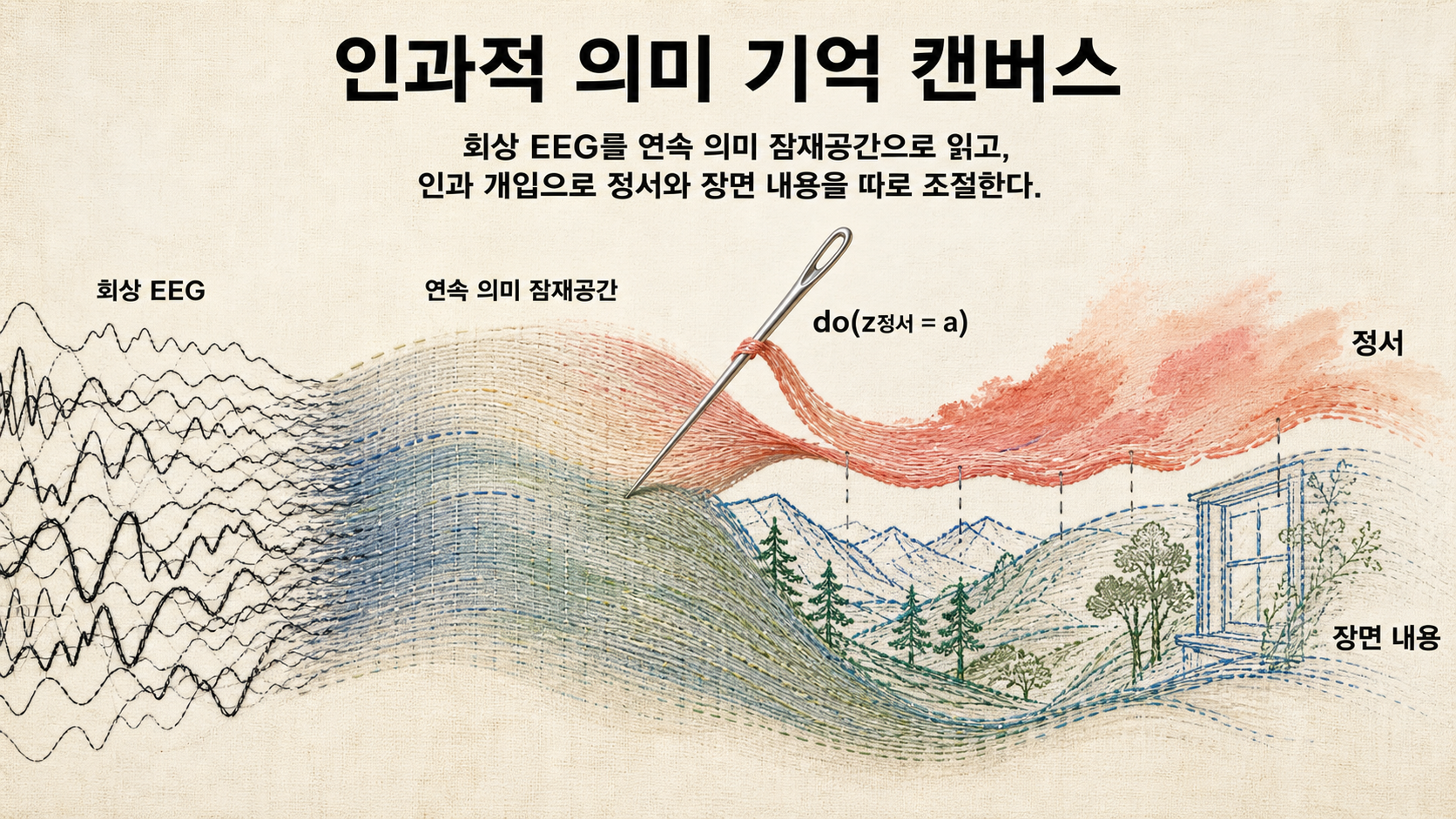
Predicting continuous semantic latents from recall EEG and intervening on causal latent factors will separately control affect and scene content in audiovisual reconstructions.
Rationale
BLPM and EEG-JEPA enable semantic and state prediction. Combining them with the lab’s memory reconstruction and latent causal discovery can turn plausible generation into testable causal control.
Related lab research
Revisiting Your Memory
Latent-Space Causal Discovery
Mind the Gap
Research informing the idea
Continuous-Latent Predictive Modeling with Semantic Alignment for EEG-Language Foundation Models
EEG-JEPA: Structured Latent Prediction for EEG Foundation Models
Proposed experiment
Use existing affect-context memory EEG and stimulus descriptions to train a CELP+N-MET encoder with a causal latent head. Compare Recall@10, affect CCC, and intervention specificity against the current generator.
Risks and limitations
Semantic latents may encode stimulus labels and generator priors rather than recalled experience.
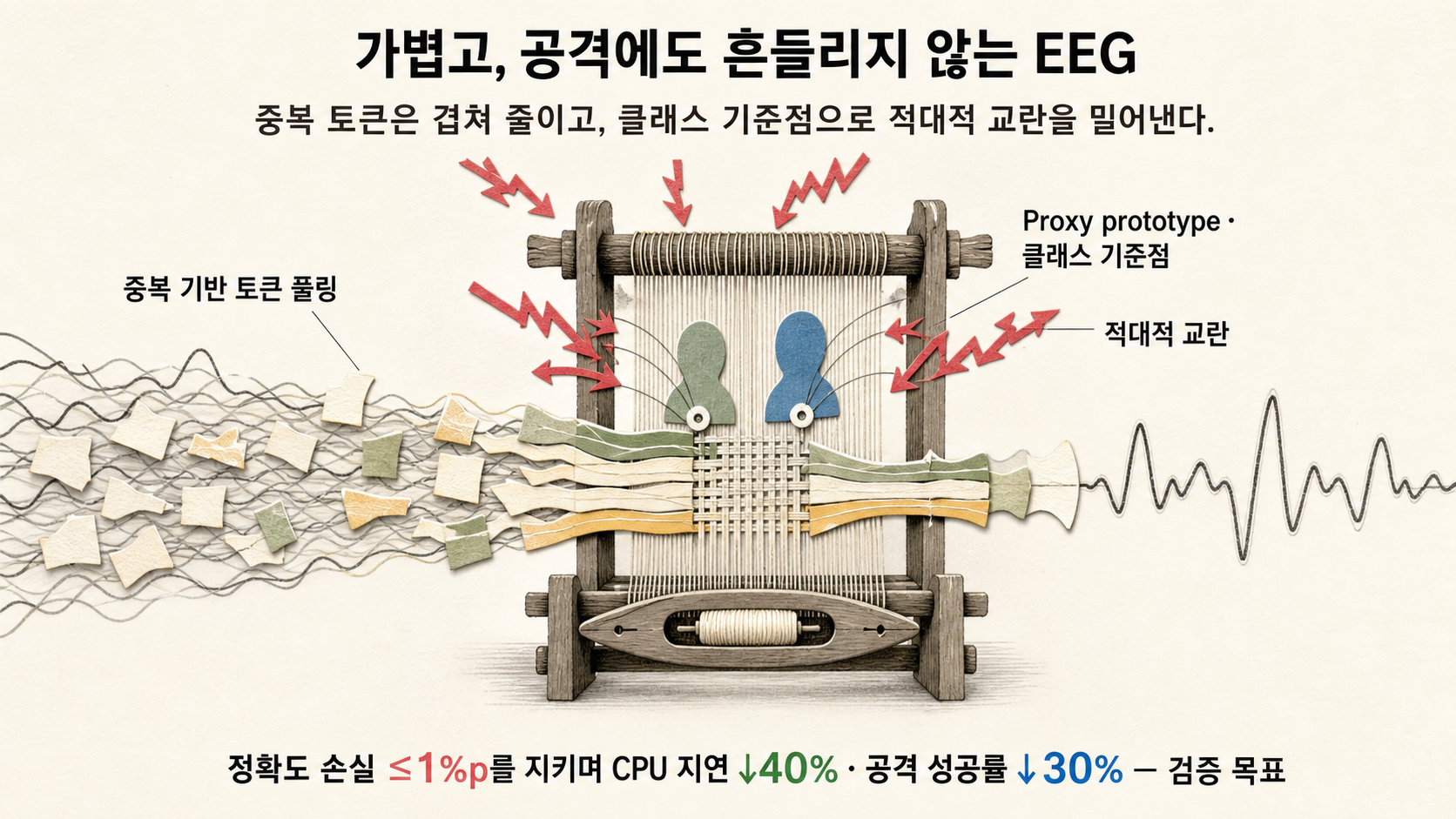
Redundancy-aware token pooling plus proxy-prototype adversarial training will reduce CPU latency by 40% and attack success by 30%, with under one-point loss in balanced accuracy.
Rationale
ZIPBrain enables local deployment, while SW-ProxyCE exposes a new attack surface. Testing both together extends the lab’s trustworthy clinical AI work from prediction reliability to model security.
Related lab research
DIVER-0
Q-DIVER
Toward trustworthy clinical AI for OCD
Research informing the idea
ZIPBrain: Can EEG Foundation Models Be Faster, Locally Deployable, but Accurate?
SW-ProxyCE: Zero-Query Adversarial Transfer from Public EEG Encoders to Private Downstream Models
Proposed experiment
Add ZIPBrain pooling to DIVER-0 and train on TUAB EEG with SW-ProxyCE examples from a public encoder. Measure CPU latency, MACs, balanced accuracy, and attack success rate on a private head.
Risks and limitations
A lower measured attack rate may reflect gradient masking rather than genuine robustness.
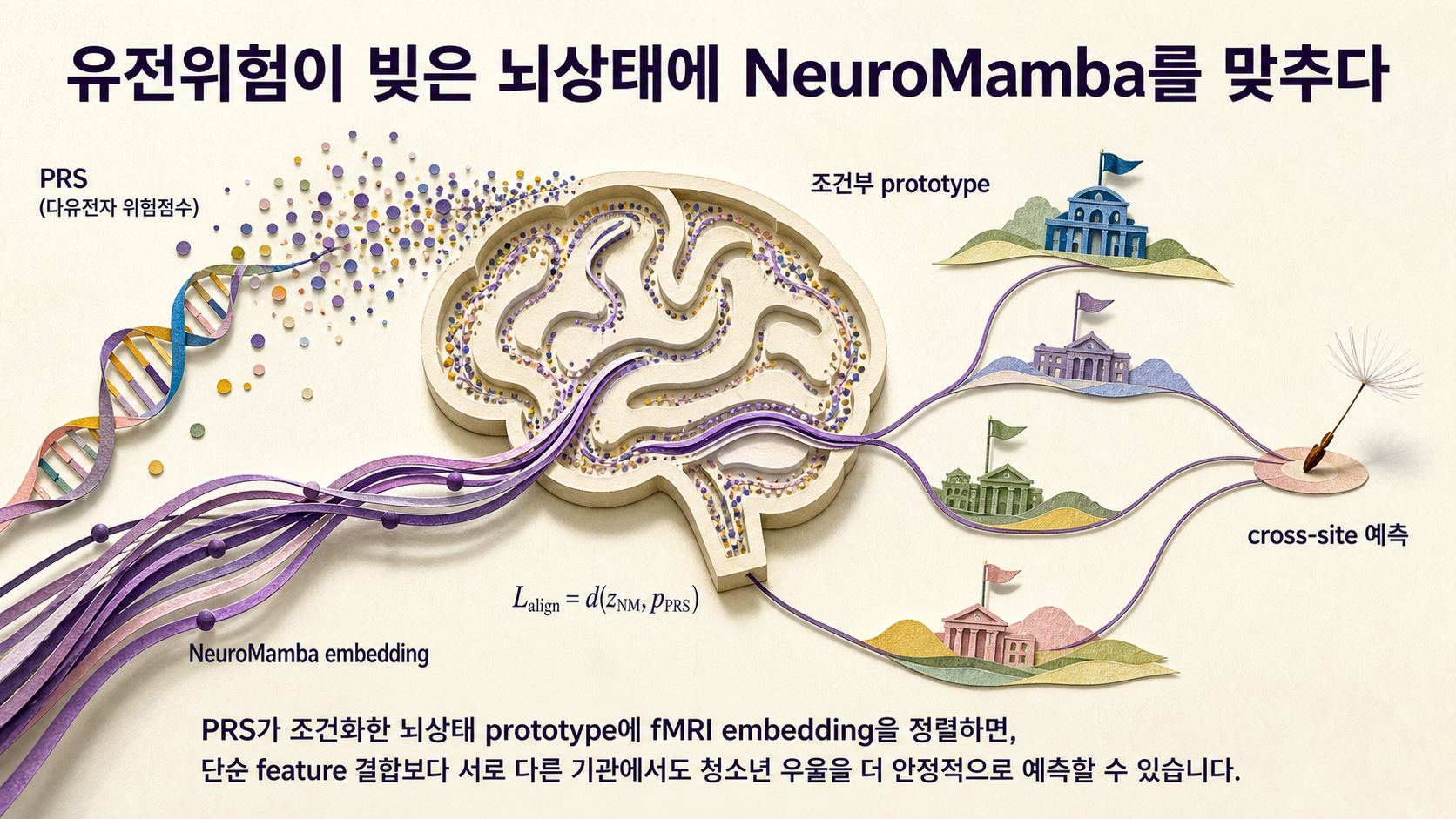
Aligning NeuroMamba embeddings to PRS-conditioned brain-state prototypes will improve cross-site prediction of youth depression over simple PRS-feature concatenation.
Rationale
EEG-PRIME shows that conditioned prototypes can improve transfer. The lab can extend this idea to genotype–fMRI alignment using its developmental genetics and foundation-model expertise.
Related lab research
NeuroMamba
Polygenic architecture of brain structure and function
Polygenic risk-informed white matter integrity
Research informing the idea
EEG-PRIME: Prototype-Aligned Representation Learning with Multi-Level Conditioning for EEG Decoding
Proposed experiment
Use ABCD genotypes, resting fMRI, adversity, and depressive symptoms with NeuroMamba plus a PRS-conditioned prototype head. Test held-out-site R², calibration error, and bootstrap prototype ARI.
Risks and limitations
Ancestry and site confounding may turn prototypes into demographic labels rather than biological states.
Affective Neuroscience
Continuous Semantic Alignment of Brain Dynamics to Art and Music via Quantum Reservoir Computing
양자 리저버 컴퓨팅을 통한 뇌 역학의 예술 및 음악과의 연속적 의미 정렬
Hypothesis
Quantum reservoir computing can model the nonlinear brain dynamics evoked by art and music better than classical approaches, enabling continuous semantic alignment between neural signals and artistic features.
Rationale
The lab studies awe and memory with EEG and experience reports, alongside separate image and music-generation methods. These threads motivate testing whether a quantum reservoir can align EEG dynamics with art and music features better than matched classical models.
Related lab research
Affective Neuroscience: Awe, Memory, and Aesthetic Experience
Quantum Machine Learning for Neuroimaging and Time-Series
fMRI & EEG Foundation Models
Research informing the idea
Continuous-Latent Predictive Modeling with Semantic Alignment for EEG-Language Foundation Models (arXiv (2026-08))
Repurposing Image Diffusion Models for Training-Free Music Style Transfer on Mel-Spectrograms (2026 IEEE International Conference on Image Processing (ICIP))
Hybrid Quantum Temporal Convolutional Networks (2026 International Conference on Quantum Communications, Networking, and Computing (QCNC))
Proposed experiment
Record EEG during abstract art and music; extract CLIP/audio embeddings from the stimuli; train a QRC to predict those embeddings from EEG and compare cosine similarity against classical reservoirs and RNNs.
Risks and limitations
Semantic features of abstract art are subjective, QRC models are hard to interpret, and EEG data for diverse artistic experiences is scarce.
Foundation Models
Energy-Efficient and Locally Deployable EEG Foundation Models for Real-time Neuro-Art Generation
실시간 신경 예술 생성을 위한 에너지 효율적이고 로컬 배포 가능한 EEG 파운데이션 모델
Hypothesis
By integrating redundancy-aware token pooling and low-frequency bias correction with EEG foundation models, we can develop energy-efficient and locally deployable models capable of real-time, low-latency reconstruction of affect-contextualized memories or creative states for interactive neuro-art applications.
Rationale
The lab has a strong commitment to the convergence of neuroscience and art, with projects like 'EEG Reconstruction & Interactive Media' and 'Revisiting Your Memory'. However, current foundation models can be computationally intensive, limiting real-time interaction. Recent external work on ZIPBrain and understanding/correcting low-frequency bias directly addresses the need for faster, more deployable, and robust EEG foundation models. This synergy can enable truly interactive and responsive neuro-art experiences that are both scientifically grounded and artistically innovative.
Related lab research
Affective Neuroscience: Awe, Memory, and Aesthetic Experience
fMRI & EEG Foundation Models
Revisiting Your Memory: Reconstruction of Affect-Contextualized Memory via EEG-guided Audiovisual Generation
Research informing the idea
ZIPBrain: Can EEG Foundation Models Be Faster, Locally Deployable, but Accurate? (arXiv (2026-08))
Understanding and Correcting Low-Frequency Bias in EEG Foundation Model (arXiv (2026-08))
Repurposing Image Diffusion Models for Training-Free Music Style Transfer on Mel-Spectrograms (2026 IEEE International Conference on Image Processing (ICIP))
Proposed experiment
Integrate the ZIPBrain redundancy-aware token pooling module into an existing EEG-guided audiovisual generation pipeline (e.g., the one from 'Revisiting Your Memory'). Additionally, implement a low-frequency bias correction method (as suggested by the 'Understanding and Correcting Low-Frequency Bias' paper) within the EEG encoder. Evaluate the model's performance in terms of generation quality (e.g., FID score for generated images/audio), latency, and computational resource usage on a low-power edge device, comparing it against the original, unoptimized pipeline for reconstructing target affective states from EEG.
Risks and limitations
Reducing model complexity for deployability might compromise the richness and nuance of the reconstructed artistic output. The real-time generation of complex, high-quality multimodal art from potentially noisy EEG signals is still a significant technical challenge. Ensuring a seamless, low-latency user experience requires robust hardware-software co-optimization. The artistic relevance and subjective quality of 'AI-generated art' can be contentious.
Genetics & Psychiatry
Multi-Modal Quantum-Enhanced Causal Discovery for Psychiatric Trajectories
Combining quantum ML with multimodal data (genetics, neuroimaging, environment) enables more accurate causal discovery of psychiatric-trajectory factors than classical latent-space methods.
Rationale
The lab studies relationships among genetic, brain, behavioral, and environmental measures, and develops models to predict mental-health outcomes. This suggests testing quantum and classical representations for causal discovery under the same assumptions and data constraints.
Related lab research
Computational Psychiatry & Multi-Modal Genetics
Quantum Machine Learning for Neuroimaging and Time-Series
The Neuro-X Project: Towards Large Brain Models
Research informing the idea
Latent-Space Causal Discovery from Indirect Neuroimaging Observations (arXiv (Cornell University))
Polygenic risk-informed white matter integrity improves deep learning-based prediction of youth depression (Communications Medicine)
Polygenic architecture of brain structure and function, behaviors, and psychopathologies in children (Nature Communications (2025))
Q-DIVER: Integrated Quantum Transfer Learning and Differentiable Quantum Architecture Search with EEG Data (2026 International Conference on Quantum Communications, Networking, and Computing (QCNC))
Proposed experiment
First check whether genetic, white-matter, environmental and longitudinal depression measures are available for the same participants. Compare quantum and classical methods on simulated data with known causal structure, then assess sensitivity to assumptions and prediction in observational data.
Risks and limitations
Quantum causal-discovery algorithms are nascent, hard to interpret, and statistical power for subtle causal effects in limited samples remains a hurdle.
Foundation Models
Multimodal Brain-Language Foundation Models with Semantic Alignment for Neuro-Psychiatric Trajectory Prediction
정신과적 궤적 예측을 위한 의미론적 정렬 다중모달 뇌-언어 파운데이션 모델
Hypothesis
By aligning continuous EEG/fMRI latent representations with large language models through multi-query semantic decomposition, we can build a multimodal brain-language foundation model that predicts mental health trajectories more accurately and provides linguistically interpretable insights into neural correlates of psychiatric conditions.
Rationale
Neuro-X develops models for understanding cognition and behavior from brain recordings. Brain-language alignment offers a candidate way to relate these representations to psychological descriptions; applying it to mental-health prediction is a proposal to test.
Related lab research
The Neuro-X Project: Towards Large Brain Models
Computational Psychiatry & Multi-Modal Genetics
fMRI & EEG Foundation Models
Mind the Gap: Aligning the Brain with Language Models Requires a Nonlinear and Multimodal Approach
Polygenic risk-informed white matter integrity improves deep learning-based prediction of youth depression
Research informing the idea
Continuous-Latent Predictive Modeling with Semantic Alignment for EEG-Language Foundation Models (arXiv (2026-08))
Polygenic architecture of brain structure and function, behaviors, and psychopathologies in children (Nature Communications (2025))
Proposed experiment
Start with ABCD fMRI and mental-health measures. Use NeuroMamba to encode fMRI, align its representations with text embeddings of assessment items, and compare held-out prediction with an otherwise identical model without language alignment.
Risks and limitations
Aligning complex, noisy neural signals with high-dimensional, abstract language embeddings is inherently challenging. The 'semantic gap' might be larger than anticipated, requiring sophisticated alignment techniques. Data scarcity for rich, multimodal (EEG/fMRI + clinical texts + genetic) datasets is a practical limitation. Ensuring that the linguistic interpretations are genuinely reflective of neural activity and not just superficial correlations will require careful validation.
Foundation Models
Quantum-Enhanced Interpretable EEG Foundation Models for Clinical Neuroscience
임상 신경과학을 위한 양자 강화 해석 가능한 EEG 파운데이션 모델
Hypothesis
Integrating parameterized quantum circuits with state-of-the-art EEG foundation models (like those leveraging structured latent prediction or prototype-aligned learning) can enhance their interpretability and generalizability across diverse clinical populations, particularly by improving the physiological relevance of attribution scores or prototype representations.
Rationale
The lab studies EEG representation learning with DIVER and quantum learning with Q-DIVER. EEG-PRISM and EEG-JEPA motivate testing whether a quantum module changes attribution quality or transfer; any benefit over classical methods remains to be tested.
Related lab research
Quantum Machine Learning for Neuroimaging and Time-Series
DIVER-0: Fully Channel-Equivariant EEG Foundation Model
Q-DIVER: Integrated Quantum Transfer Learning
Toward trustworthy clinical AI for obsessive-compulsive disorder: reliability, generalizability, and interpretability of a transformer model across the ENIGMA-OCD consortium
Research informing the idea
EEG-PRISM: Physiologically-Grounded Interpretability of Predictions by EEG Foundation Models (arXiv (2026-08))
EEG-JEPA: Structured Latent Prediction for EEG Foundation Models (arXiv (2026-07))
Q-DIVER: Integrated Quantum Transfer Learning and Differentiable Quantum Architecture Search with EEG Data (2026 International Conference on Quantum Communications, Networking, and Computing (QCNC))
Proposed experiment
Implement a quantum-enhanced interpretability module by replacing a classical attention or latent space component within an existing EEG-JEPA or EEG-PRIME architecture with a parameterized quantum circuit (PQC). Evaluate the physiological plausibility of the resulting attribution maps (using EEG-PRISM's frequency/source domain mapping) and compare generalizability metrics (e.g., cross-subject accuracy) on a publicly available EEG dataset for a cognitive task (e.g., P300) against the classical baseline.
Risks and limitations
Quantum hardware limitations and noise remain a significant challenge, potentially limiting the complexity of PQCs that can be effectively integrated. Demonstrating a clear and tangible 'quantum advantage' for interpretability or generalizability over sophisticated classical methods might be difficult in the near term. The computational overhead of QML could also hinder speed and deployability.
Foundation Models
Quantum-Enhanced Spatio-Temporal Alignment for EEG Foundation Models with Physiologically-Grounded Interpretability
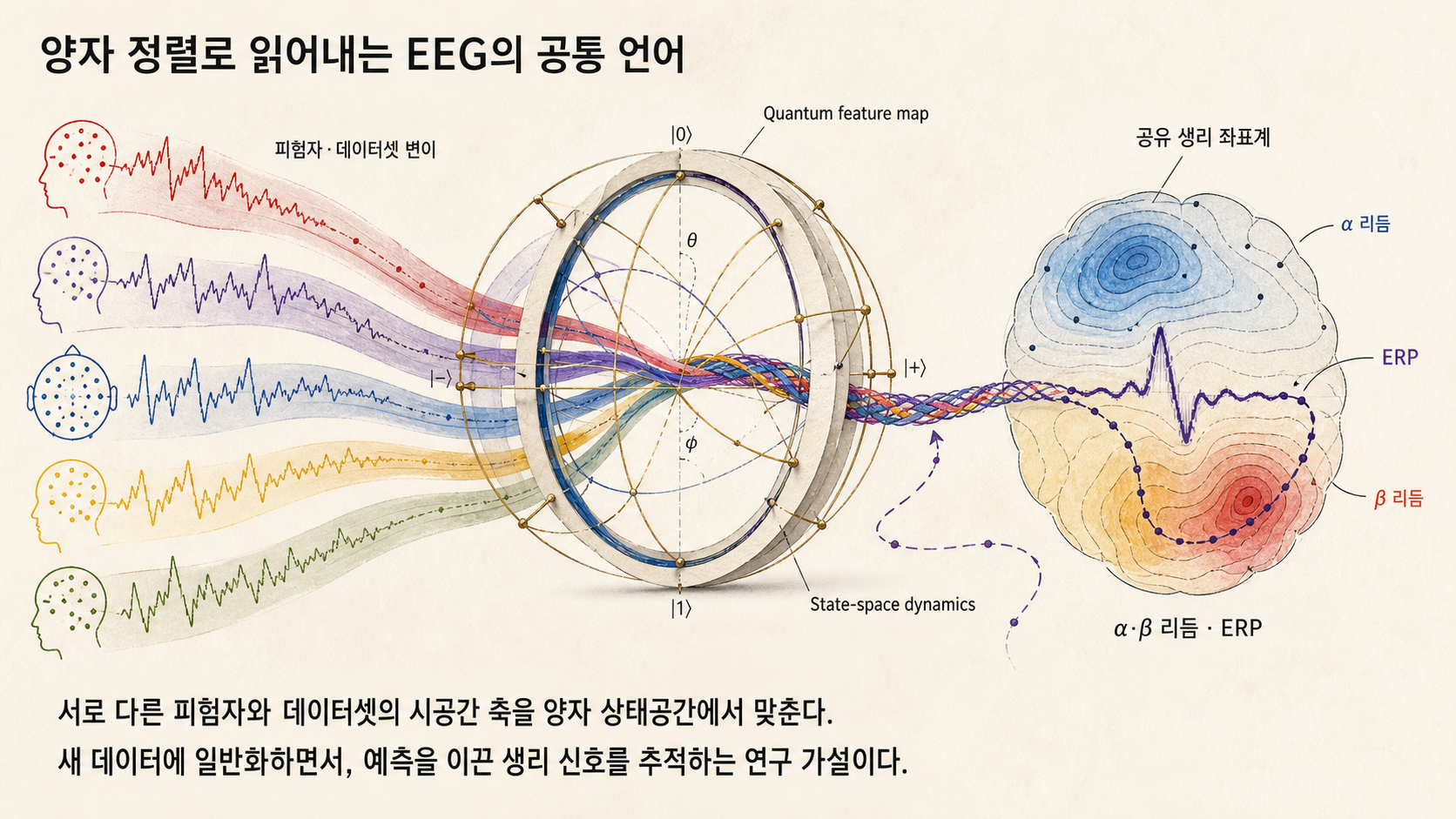
Quantum spatio-temporal alignment inside EEG foundation models improves cross-dataset and cross-subject generalization while enabling physiologically grounded interpretability.
Rationale
Recent EEG foundation models (STEAM, EEG-PRISM) demand robust spatio-temporal alignment and interpretability — a natural fit for a lab strong in both QML and state-space models.
Related lab research
fMRI & EEG Foundation Models
Quantum Machine Learning for Neuroimaging and Time-Series
EEG Reconstruction & Interactive Media
Research informing the idea
STEAM: A Spatio-TEmporal Alignment Mixture-of-Experts Model with Hierarchical Pre-training for EEG Decoding (arXiv (2026-08))
EEG-PRISM: Physiologically-Grounded Interpretability of Predictions by EEG Foundation Models (arXiv (2026-08))
Q-DIVER: Integrated Quantum Transfer Learning and Differentiable Quantum Architecture Search with EEG Data (2026 International Conference on Quantum Communications, Networking, and Computing (QCNC))
Proposed experiment
Add a parameterized-quantum-circuit alignment module to a STEAM-like model, train on PhysioNet motor-imagery EEG, compare cross-subject accuracy/F1 against classical STEAM, and interpret features with EEG-PRISM.
Risks and limitations
Quantum-hardware noise and qubit limits constrain circuit complexity, and physiological interpretability is hard to validate without ground truth.